Note
Go to the end to download the full example code.
K’gari transect plot#
import shapely
import matplotlib.pyplot as plt
from matplotlib import gridspec
from matplotlib.colors import LogNorm, PowerNorm

import emsarray
from emsarray import plot, transect, utils
from emsarray.operations import depth

dataset_url = 'https://thredds.nci.org.au/thredds/dodsC/fx3/gbr4_H4p0_ABARRAr2_OBRAN2020_FG2Gv3_Dhnd/gbr4_simple_2022-10-01.nc'
# dataset_url = '~/example-datasets/gbr4_simple_2022-10-31.nc'
dataset = emsarray.open_dataset(dataset_url).isel(time=12)
# Select only the variables we want to plot.
dataset = dataset.ems.select_variables(['botz', 'temp', 'eta'])
# The depth coordinate has positive=up, while the bathymetry has positive=down.
# This causes issues when drawing the ocean floor.
# Lets fix the depth coordinate.
dataset = depth.normalize_depth_variables(dataset, ['zc'], positive_down=True)
# Cross section plots need bounds information, so lets invent some
dataset = utils.estimate_bounds_1d(dataset, 'zc')
The following is a transect path
starting in the Great Sandy Strait near K’gari,
heading roughly North out to deeper waters:
north_transect = transect.Transect(dataset, shapely.LineString([
    [152.9768944, -25.4827962],
    [152.9701996, -25.4420345],
    [152.9727745, -25.3967620],
    [152.9623032, -25.3517828],
    [152.9401588, -25.3103560],
    [152.9173279, -25.2538563],
    [152.8962135, -25.1942238],
    [152.8692627, -25.0706729],
    [152.8623962, -24.9698750],
    [152.8472900, -24.8415806],
    [152.8308105, -24.6470172],
    [152.7607727, -24.3521012],
    [152.6392365, -24.1906056],
    [152.4792480, -24.0615124],
]))
landmarks = [
    ('Round Island', shapely.Point(152.9262543, -25.2878719)),
    ('Lady Elliot Island', shapely.Point(152.7145958, -24.1129146)),
]
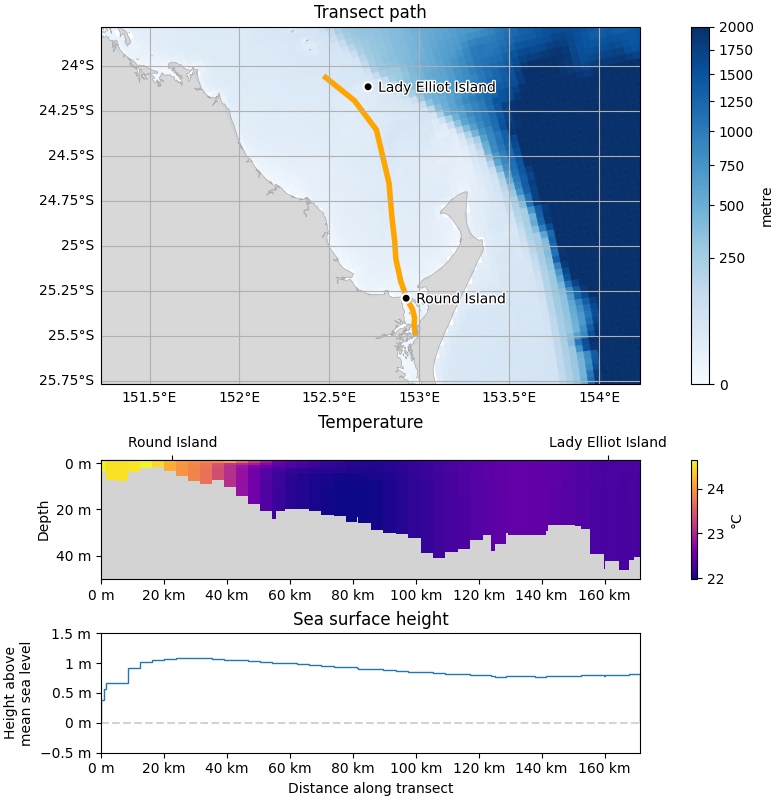
Set up three axes: one showing the transect path, one showing a temperature cross section along the transect, and one showing the sea surface height along the transect.
figure = plt.figure(figsize=(7.8, 8), layout='constrained', dpi=100)
gs_root = gridspec.GridSpec(3, 1, figure=figure, height_ratios=[3, 1, 1])
path_axes = figure.add_subplot(gs_root[0], projection=dataset.ems.data_crs)
temp_axes = figure.add_subplot(gs_root[1])
eta_axes = figure.add_subplot(gs_root[2], sharex=temp_axes)
First make a plot showing the path of the transect overlayed on the bathymetry
path_axes.set_aspect(aspect='equal', adjustable='datalim')
path_axes.set_title('Transect path')
dataset.ems.make_artist(
    path_axes, 'botz', cmap='Blues', clim=(0, 2000), edgecolor='face',
    norm=PowerNorm(gamma=0.5),
    linewidth=0.5, zorder=0)
path_axes.set_extent(plot.bounds_to_extent(north_transect.line.envelope.buffer(0.2).bounds))
path_axes.plot(*north_transect.line.coords.xy, zorder=1, c='orange', linewidth=4)

plot.add_coast(path_axes, zorder=1)
plot.add_gridlines(path_axes)
plot.add_landmarks(path_axes, landmarks)
Now plot a cross section along the transect showing the ocean temperature. As the temperature variable has a depth axis the cross section is two dimensional.
temp_axes.set_title('Temperature')
dataset['temp'].attrs['units'] = '°C'
dataset['zc'].attrs['long_name'] = 'Depth'

north_transect.make_artist(
    temp_axes, 'temp', cmap='plasma')
north_transect.make_ocean_floor_artist(
    temp_axes, dataset['botz'])
# yaxis
transect.setup_depth_axis(
    north_transect, temp_axes, data_array='temp',
    label='Depth', ylim=(50, -1.5))
Now plot the sea surface height along the transect. As the sea surface height does not have a depth axis the transect is one dimensional.
eta_axes.set_title('Sea surface height')
eta_artist = north_transect.make_artist(
    eta_axes, data_array=dataset['eta'])
# xaxis
transect.setup_distance_axis(north_transect, eta_axes)
# yaxis
eta_axes.set_ylim(-0.5, 1.5)
eta_axes.set_ylabel('Height above\nmean sea level')
eta_axes.axhline(0, linestyle='--', color='lightgrey')
eta_axes.yaxis.set_major_formatter("{x:.2g} m")
The last step is to add some landmarks along the top border of the axes to help viewers link the distance along transect path to geographic locations.
top_axis = temp_axes.secondary_xaxis('top')
top_axis.set_ticks(
    [north_transect.distance_along_line(point) for label, point in landmarks],
    [label for label, point in landmarks],
)


plt.show()
Total running time of the script: (0 minutes 15.953 seconds)